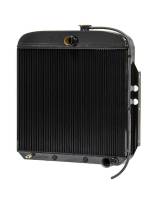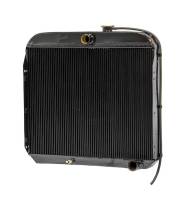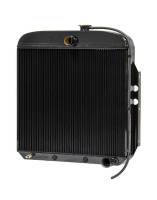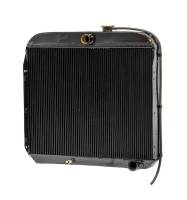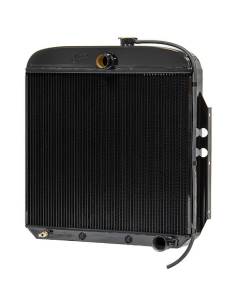
Our brass and copper radiator inventory addresses all Tri-Five cooling requirements, from inline-six applications to big-block V8 conversions. These radiators maintain original mounting configurations, inlet and outlet positions, and external appearance while incorporating four-core construction that delivers enhanced cooling capacity compared to original two-core and three-core designs. This approach preserves authentic radiator styling while providing cooling performance adequate for contemporary driving conditions.
Advantages of Brass and Copper Construction
Brass and copper radiators offer distinct advantages appreciated by restoration enthusiasts and traditional craftsmen. The materials provide excellent thermal conductivity, efficiently transferring heat from the coolant to the surrounding air. Unlike aluminum radiators, which require specialized equipment for repair, brass and copper radiators can be serviced by traditional radiator shops using conventional soldering techniques. This repairability proves valuable for owners committed to long-term vehicle preservation, ensuring radiators remain serviceable for decades.
The visual appearance of brass and copper radiators maintains authenticity critical for concours restorations and show vehicles judged on originality. Tank finishes, core designs, and overall construction replicate period-correct radiator characteristics that distinguish authentic restorations from modified vehicles. The weight and heft of brass and copper construction also match original radiator characteristics, maintaining proper front-end weight distribution for handling and suspension geometry.
Traditional construction methods ensure compatibility with original radiator mounting systems, core supports, and hose configurations. No modifications or adaptations are required for installation in stock applications. The radiators fit exactly as original equipment, maintaining proper clearances, mounting points, and cooling system geometry.
Four-Core Performance Enhancement
While maintaining an authentic appearance, modern brass and copper radiators typically feature four-core construction compared to original two-core or three-core designs. Additional core rows increase cooling surface area, enhancing heat dissipation capacity without altering external dimensions or mounting configurations. This upgrade proves particularly valuable for Tri-Fives equipped with air conditioning, operating in hot climates, or experiencing heavy traffic conditions.
Four-core construction accommodates both stock and modified engine applications. Standard inline-six and small-block V8 engines benefit from enhanced cooling capacity that prevents overheating during extended idling or slow-speed operation. Performance engines with increased heat generation require additional cooling capacity that four-core designs provide. The enhanced capacity creates a cooling system margin that prevents temperature concerns under demanding conditions.
Application-Specific Configurations
Tri-Five radiators vary based on engine type, transmission configuration, and model year variations. Inline-six radiators differ from V8 applications in inlet and outlet positioning to match engine-specific water pump locations. Automatic transmission-equipped vehicles require integrated transmission cooler provisions, while manual transmission applications eliminate this feature. H&H Classic Parts stocks radiators addressing these specific configurations, ensuring correct fitment for your particular Tri-Five.
Core support variations between 1955, 1956, and 1957 models affect radiator mounting and require year-specific components. Our inventory addresses these distinctions, providing radiators engineered for correct installation in specific model years. Technical specifications, including radiator height, width, core thickness, and mounting point locations, match original dimensions, ensuring proper fitment without modifications.
Quality Manufacturing Standards
Modern brass and copper radiators benefit from improved manufacturing techniques compared to 1950s production methods. Precision core construction, superior soldering quality, and enhanced material purity result in radiators often exceeding original equipment durability. Tank construction utilizes proper gauge brass with reinforced seams resistant to pressure cycling and thermal stress. Core tubes and fins feature optimal spacing and construction for maximum heat transfer efficiency.
Quality control standards ensure leak-free construction and proper pressure capacity. Each radiator undergoes testing, verifying structural integrity and cooling performance before shipment. This quality assurance eliminates common issues affecting vintage radiators, including core leaks, tank seam failures, and inadequate cooling capacity.
Installation and Maintenance Considerations
Installing brass and copper radiators mirrors the original radiator replacement procedures. Standard radiator mounting hardware, upper and lower hoses, and overflow connections install without modifications or special tools. The radiators work with original cooling system components, including water pumps, thermostats, and fan shrouds, maintaining complete system compatibility.
Maintenance requirements follow traditional radiator service practices. Regular coolant changes prevent internal corrosion and scale buildup that compromise cooling efficiency. External cleaning maintains optimal airflow through core fins. Should repairs become necessary, traditional radiator shops can service brass and copper construction using conventional techniques, unlike specialized aluminum radiator repairs requiring welding equipment unavailable at many facilities.
FAQs: 1955-1957 Chevy 150, 210, and Bel Air Brass and Copper Radiators
Q: Why choose brass and copper radiators over aluminum radiators?
A: Brass and copper radiators offer several advantages for specific applications and preferences. They maintain an authentic period-correct appearance essential for concours restorations and judged show vehicles. They can be repaired using traditional soldering techniques at conventional radiator shops, while aluminum requires specialized welding equipment. Brass and copper radiators match original weight and construction methods, appealing to restoration purists. They're ideal for stock or mildly modified engines without air conditioning. However, aluminum radiators provide superior cooling performance (typically 25 to 35 percent better), weigh significantly less, and better serve high-performance applications or vehicles with air conditioning. The choice depends on your restoration philosophy and cooling requirements.
Q: What does "4-core" mean, and why is it important?
A: Core count refers to the number of rows of coolant tubes running through the radiator from top to bottom. Original Tri-Five radiators typically featured two-core or three-core construction. Four-core radiators add an additional row of tubes, increasing cooling surface area and heat dissipation capacity without changing external radiator dimensions. This enhanced capacity prevents overheating in demanding conditions like traffic congestion, hot weather, or when running air conditioning. The additional cooling capacity creates a safety margin that keeps engines at optimal temperatures even under stress. Four-core construction represents a practical upgrade that maintains an authentic appearance while improving performance.
Q: Will these radiators fit my Tri-Five without modifications?
A: Yes, these radiators are manufactured as direct replacements using original mounting points, dimensions, and connection locations. They install exactly like original radiators without requiring modifications to core supports, hose routing, or mounting hardware. However, selecting the correct radiator for your specific application is critical. Radiators differ based on engine type (inline-six vs. V8), transmission type (manual vs. automatic), and model year (1955, 1956, or 1957). Our technical team can help identify the correct radiator for your particular Tri-Five configuration, ensuring proper fitment and function without modifications.
Q: Can brass and copper radiators handle modern coolants and additives?
A: Yes, modern brass and copper radiators are compatible with contemporary coolant formulations, including ethylene glycol and propylene glycol-based antifreeze. The materials resist corrosion from modern coolant additives when proper coolant mixture ratios are maintained, and regular service intervals are followed. Using quality coolant and changing it according to manufacturer recommendations prevents internal corrosion and scale buildup. Avoid using overly aggressive additives or neglecting coolant service, as these can damage any radiator material over time. Following basic cooling system maintenance ensures brass and copper radiators provide decades of reliable service.
Q: How do I choose between radiators for different engine and transmission combinations?
A: Radiator selection depends on several factors. Engine type determines inlet and outlet positioning, with inline-six radiators differing from V8 applications to match water pump locations. Transmission type affects whether you need integrated transmission cooler provisions (automatic transmission) or not (manual transmission). Generally, V8 applications require greater cooling capacity than inline-six engines. If you have air conditioning or a performance engine, consider maximum cooling capacity options. Our catalog identifies specific applications for each radiator, and our technical team can help you select the appropriate radiator based on your Tri-Five's engine, transmission, and equipment. Providing your vehicle's complete specifications ensures you receive the correct radiator for optimal cooling performance and proper fitment.